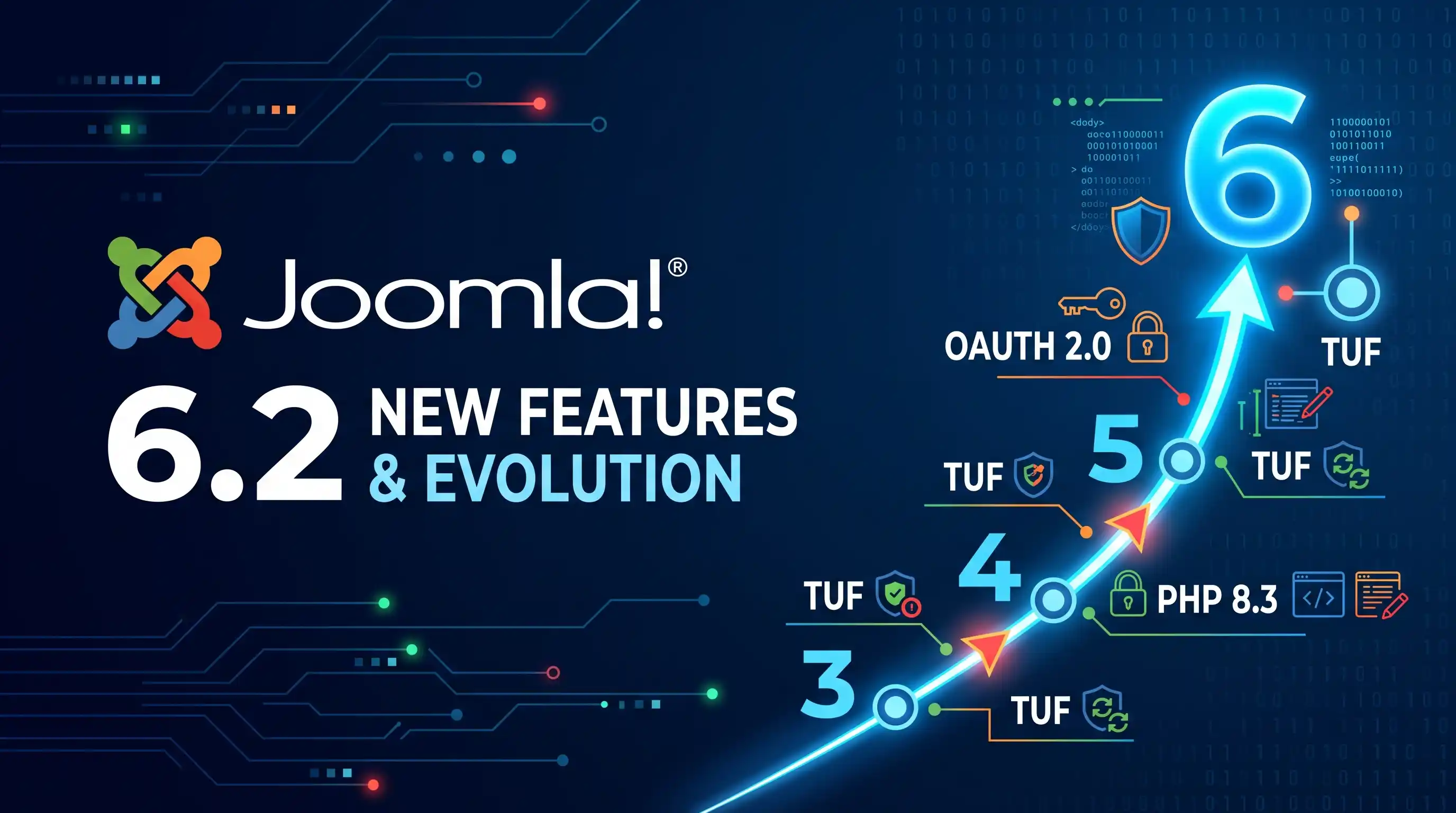
The Joomla ecosystem establishes a modern architecture centered on enterprise-grade security, automation, and a refined workflow for content creators and developers alike.
What's New in Joomla 6.2?
OAuth 2.0 SMTP Authentication
Replaces static app passwords with secure OAuth 2.0 authentication, offering native out-of-the-box compatibility with Microsoft 365 and Google Workspace.
Temporary Preview Links
Generate signed, time-limited tokens to easily share drafts and unpublished content with clients and reviewers without requiring front-end logins.
Language Fallback Chain
Translation cascade for multilingual sites: if an active language string is missing, the system gracefully falls back through a defined chain before defaulting to raw keys.
Unified Link Picker
A redesigned modal inside TinyMCE to quickly search and insert internal links covering articles, contacts, and menu items in a single consolidated interface.
TinyMCE Improvements
Strict compliance with global text filtering rules by default, coupled with tighter, direct integration with the native Media Manager.
Web Services API Upgrades
Native separation of introtext and fulltext fields in content endpoints, plus category filtering by publication state.
What Sets Joomla 6 Apart from Earlier Generations?
1. Automatic Core Security Updates
Unlike versions 3, 4, and 5 (which required manual intervention or third-party cron setups), Joomla 6 integrates automated core updates backed by The Update Framework (TUF), applying cryptographically verified security patches hands-free.
2. Strict Modern Baseline (PHP 8.3+)
While Joomla 3 supported legacy PHP 5.x/7.x and Joomla 4/5 allowed PHP 8.1, Joomla 6 mandates PHP 8.3 as the strict minimum requirement, driving down memory footprints and speeding up dynamic request cycles.
3. Visual Workflow Builder & Proof-of-Work (PoW) CAPTCHA
Design custom publishing pipelines through interactive workflow diagrams. At the same time, native invisible Proof-of-Work puzzles mitigate bot submissions without disrupting visitors with tedious visual challenges.
4. Standardized Child Templates
Eliminates the legacy risk of having custom overrides wiped during theme updates by enforcing an isolated, maintainable child template structure.
5. Native Next-Gen Media Management
Full, end-to-end integration for modern formats like WebP and AVIF, backed by in-browser cropping, resizing, and responsive thumbnail generation.
Generational Comparison
| Feature / Capability | Joomla 3 | Joomla 4 | Joomla 5 | Joomla 6 (6.0 to 6.2) |
|---|---|---|---|---|
| Support Status | End of Life | End of Life | Security Only | Active (New Features) |
| Minimum PHP | PHP 5.3 / 7.x | PHP 7.2.5 | PHP 8.1 | PHP 8.3 |
| Email Dispatch | Static SMTP | Static SMTP | Static SMTP | OAuth 2.0 (Google / M365) |
| Core Updates | Manual | Manual | Manual / CLI | Automated via TUF |
| Headless API | Not native | Basic REST API | Expanded REST API | Full Web Services with granular filters |
| Child Templates | Not native | Introduced (4.1) | Stable | Standardized core implementation |
| Draft Preview | Required login | Required ACL access | Required ACL access | Signed temporary link without login |
How Does Migration Work?
- Upgrading from Joomla 5.4: The transition is direct. Leveraging the built-in Backward Compatibility Plugin, well-maintained extensions continue working smoothly once the host environment runs PHP 8.3+.
- Migrating from Joomla 3 or 4: This should be planned as a staged migration project. The recommended roadmap is to first update to Joomla 5.4, audit and resolve legacy third-party extension dependencies, and then upgrade to the 6.x release line.